Building a PSP strategy for a multi-rail future

Dutch A2A payments are entering a new phase. As the European payments landscape consolidates around standardised, pan-European approaches, merchants are – for the first time in years – actively reassessing payment infrastructure, risk models, and future strategy. The strategic implication for payment service providers (PSPs) is clear: Dutch A2A payments are moving from one dominant local method to a more dynamic multi-rail environment. The real opportunity is the PSP’s shifting role – helping merchants manage that uncertainty and set the right strategy for the multi-rail market ahead.
Dutch A2A payments are entering a new multi-rail era, creating new opportunities and challenges for PSPs as merchants reassess payment strategies, pricing models, risk management, and payment flexibility.
PSPs can play a more strategic role by helping merchants navigate disputes, fraud, recurring payments, settlement changes, and payment method optimization while expanding into value-added services beyond payment acceptance.
Pay by Bank and open banking solutions like Tink provide PSPs with a scalable way to offer payment optionality, improve merchant experiences, reduce risk, and prepare for the future of European commerce.
A market built on bank payments
Few payment ecosystems are as clean a success story as the Netherlands' (1). Over more than twenty years, bank-based payments quietly became the default way Dutch consumers pay online – not because it was mandated, but because it worked. Bank payments that felt trusted. Familiar. Certain. Today, the vast majority of Dutch ecommerce runs on account-to-account payments, making this one of the strongest and most mature ecosystems in Europe (2). And it’s entering a new chapter.
What the shift means for PSPs
For PSPs, the shift is about far more than updating a logo at checkout. New dispute and buyer-protection processes, evolving commercial models, and additional payment capabilities all change how account to account (A2A) payments are managed. While merchants are watching the direct impact on pricing, disputes, and operational complexity, PSPs will increasingly be expected to help them navigate the change. Payment acceptance, historically a core revenue and conversion driver, now becomes a source of change and uncertainty too.
Merchants are asking new questions about cost, risk and flexibility, and those questions flow back to PSPs. That's an opening: PSPs can move beyond payment acceptance alone and play a more strategic role in helping merchants optimise payments, onboarding, verification and risk management.
The opportunity for PSPs is building a payments platform that's ready for what comes next. That means evaluating how additional A2A payment options, open banking capabilities and value-added services work together – creating stronger merchant propositions and new revenue, ahead of merchant demand.Here's what that means for PSPs, taking each challenge in turn:
Disputes: The market is moving toward formal buyer-protection and dispute processes. For PSPs, that means building the operational processes and risk controls to support it now, not once merchants start asking how it works.
Pricing structure: The market is moving from fixed, low per-transaction fees toward percentage-based models (3). PSPs have a window now to model fee scenarios and get ahead of the conversation before commercial terms are revisited.
Settlement schedule: New dispute and buyer-protection processes may require PSPs to introduce risk controls such as delayed settlement or reserve requirements. For merchants used to fast settlement, PSPs need to explain and manage this change proactively, not after the fact.
Recurring payments: Many merchants pair A2A payments with SEPA Direct Debit for recurring billing. As newer schemes build their own recurring payments capabilities, PSPs can help merchants review, rather than rebuild, their existing setup, and flag early where feature sets don't yet match.
Feature availability: Rollouts across the market are phased and uneven, with full issuer coverage and features like subscriptions, recurring payments and refunds still being added incrementally. PSPs are best placed to tell merchants what's available today versus what's coming, and where an alternative method might bridge the gap.
Friendly fraud: These new dispute processes give merchants a formal route to raise claims, but also open the door to false claims from customers who received exactly what they ordered. Visa estimates 75% of chargeback disputes are friendly fraud (4). PSPs can help merchants treat this as a payment-method-mix question: which transaction types need buyer protection, which need low dispute exposure, which need instant confirmation, which need strong refund flows.
The key takeaway is that the most successful PSPs of the next decade are unlikely to be those offering the widest range of payment methods alone, but those helping merchants solve a wider set of business challenges through payments, data, and verification services working together.
The case for payment optionality
For PSPs looking to act on that shift towards an advisory role, payment optionality is where the opportunity becomes concrete.
As the Dutch payments landscape evolves, the market is beginning to embrace a multi-rail future, rather than positioning a single payment method as the leader.
Payments Europe's 2025 merchant survey found that 85% of merchants believe accepting a broad range of payment options has increased turnover (5) – a sign that choice now drives revenue, not just convenience.
One notable example is Pay by Bank. In the Netherlands, the Verenigde Betaalinstellingen Nederland (VBIN) has adopted “Pay by Bank” as a shared, market-facing brand name for PSD2-based A2A payments – giving merchants and consumers a clear, recognisable way to identify direct bank payments. It’s a move that reflects a broader shift towards optionality in the market.
Pay by Bank is built on infrastructure that already operates at scale, working on real-time payment rails under regulated open banking frameworks connected to over 95% of banks across the majority of European countries (6). It is a well-established example of how scalable A2A payments can work.
A familiar journey, by design
For Dutch consumers, a Pay by Bank flow will feel immediately recognisable. The experience mirrors what the market has become highly accustomed to over the years:
The payer goes through checkout.
They are redirected to their own banking environment where the payment is securely authorised.
The PSP receives instant payment confirmation, enabling the merchant to swiftly deliver confirmation to the payer.
This simplicity carries strategic weight. New payment methods typically require a period of consumer education before gaining meaningful traction. Pay by Bank does not face this challenge in the Dutch market – the user behaviour already exists. Introducing a payment option which consumers already understand removes one of the most common barriers to checkout adoption. The trust and confidence in A2A payments are already established.
This simplicity carries strategic weight. New payment methods typically require a period of consumer education before gaining meaningful traction. Pay by Bank does not face this challenge in the Dutch market – the user behaviour already exists. Introducing a payment option which consumers already understand removes one of the most common barriers to checkout adoption. The trust and confidence in A2A payments are already established.
This is the same trust that bank-based payments spent twenty years building. Pay by Bank inherits it rather than having to earn it from scratch.
Below is an example of how a Pay by Bank flow could look (7):
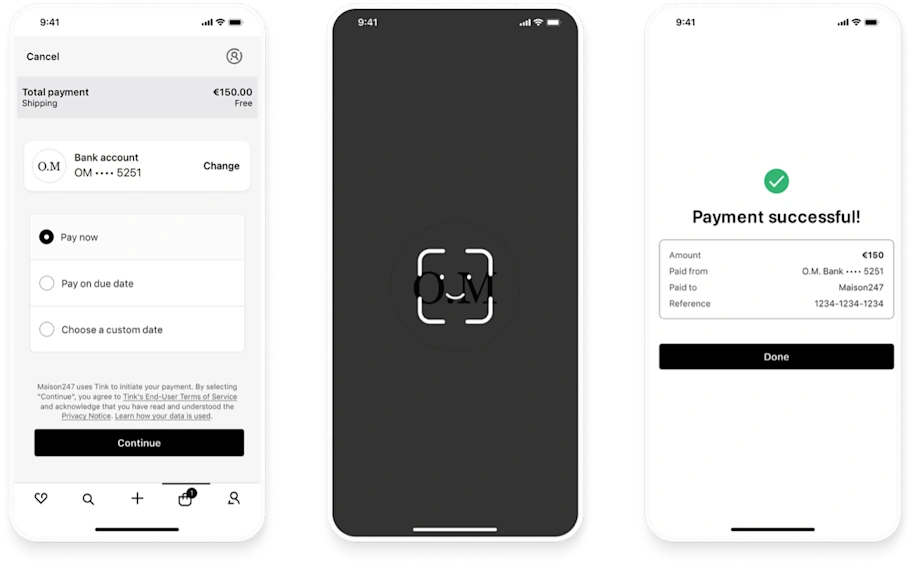
Delivered as a white-label experience, it provides you with greater ownership of the checkout journey under your own brand.
And as VBIN highlights, Pay by Bank is compatible with Europe’s Instant Payments infrastructure, allowing transactions to be executed and confirmed within seconds. Coupled with extensive EU coverage, low credit risk, zero chargebacks, low fees and fast payout speeds, Pay by Bank represents a viable additional payment method alongside existing payment strategies. (8)
The Tink solution
Wholly owned by Visa, Tink has spent the last 14 years establishing itself as a leading open banking provider, with capabilities available across 19 markets. For PSPs serving merchants with a pan-European presence, Tink offers a scalable Pay by Bank solution backed by broad European connectivity and the scale needed to support growth across borders. Beyond payments, Tink unlocks the wider value of open banking through verification, fraud prevention and data capabilities, helping businesses improve efficiency, reduce risk and prepare for the future of multi-rail commerce.
Last year, we announced reaching the milestone of 10,000 merchants using Pay by Bank via our Payment Service Provider partnerships. Within the Dutch market, Tink’s Pay by Bank offer is already well-known and widely used, performing at some of the highest levels across Europe. This is a true testament to the convenience of the solution’s user experience as well as the level of comfort and familiarity with A2A payments in the Netherlands.
Not just another payment method
Leading PSPs are introducing Pay by Bank to their checkout options, offering several advantages to their merchants – potentially lower costs, fast payments, enhanced security, optimised conversion and expanded market reach. But this isn’t the full extent of how PSPs are maximising open banking capabilities.
Twikey, (9) a European payment orchestrator with offices in Belgium, Germany and a strong footprint in the Netherlands, provides a practical example of extending the value of open banking beyond checkout.
In addition to offering Pay by Bank as a new way to check out online, Twikey are utilising Tink’s open banking services to verify account information and support fraud reduction in direct debit onboarding journeys with more reliable, bank sourced data.
“With open banking services, we solve two problems for our customers at once,” Dominique Adriansens, Twikey's CEO, says: “With Pay by Bank, we remove the middleman from the equation and remove payment ceilings that traditional methods usually impose. Secondly, with payment fraud becoming an increasingly sore issue, our customers can set up sophisticated account checks - verifying its ownership, balance and transaction history, for instance - to stop fraud before it has a chance to start.”
For payments companies, including those in the Dutch market the relevance is clear: open banking is not just about offering another payment method to their merchants. The focus is shifting more towards how payments, verification and customer data can combine to strengthen existing payment operations.
Is your payment strategy built for what’s next?
The European open banking market is forecast to grow at a compound annual rate of 26.3% between 2026 and 2033 (10). The Netherlands is not starting this journey from scratch – it is entering the next phase with one of Europe's strongest bank-based payment cultures already established, with consumers who have long treated A2A payments as the norm. And that familiarity is extremely valuable.
For PSPs, that familiarity is a head start, not a reason to wait. The merchants building their payment strategy today are the same merchants who will be asking their PSP for guidance within the year. Adding Pay by Bank as a payment option now means PSPs can build merchant propositions ahead of that demand, rather than reacting to it.
This isn't about replacing existing rails, but future-proofing A2A infrastructure for a market where merchants will expect more payment flexibility and optionality.
Interested in learning more about how Pay by Bank can be beneficial? Click here to dive into why leading PSPs like Adyen and Stripe (11) are introducing Pay by Bank to their checkout options (and why this is important for their merchants too).
1. DeNederlandscheBank, ‘Cash remains a key payment method in Europe, but its share continues to decline’ (https://www.dnb.nl/en/general-news/news-2025/cash-remains-a-key-payment-method-in-europe-but-its-share-continues-to-decline/)
2. Statista (statista.com/statistics/558358/market-share-of-online-payment-methods-in-the-netherlands/)
3. Koninklijke Nederlandse Beroepsorganisatie van Accountants, Accountant.nl (https://www.accountant.nl/achtergrond/2026/1/wat-elke-accountant-moet-weten-over-het-verdwijnen-van-ideal-en-de-komst-van-wero/)
4. Visa, ‘Fraud-as-a-service (FaaS) and furious: five fraud trends for financial institutions’
5. Payments Europe, 2025 Merchant Survey
6. Tink, ‘The key to picking an open banking payments partner: bank coverage’
7. The three-step flow shown has been simplified for space and is provided for illustrative purposes only; actual user journeys may vary depending on the PSP, bank, merchant integration and market-specific implementation
8. Juniper Research (https://www.juniperresearch.com/press/a2a-transaction-value-to-reach-195-trillion-in-2030-globally-driven-by-advanced-value-added-services/)
9. All brand names are the property of their respective owners, are used for identification purposes only, and do not imply product endorsement or affiliation with Visa
10. Grand View Research, Europe Open Banking Market report
11. All brands are the property of their respective owners, are used for identification purposes only, and do not imply product endorsement or affiliation with Visa
More in Open banking
2026-09-25
3 min read
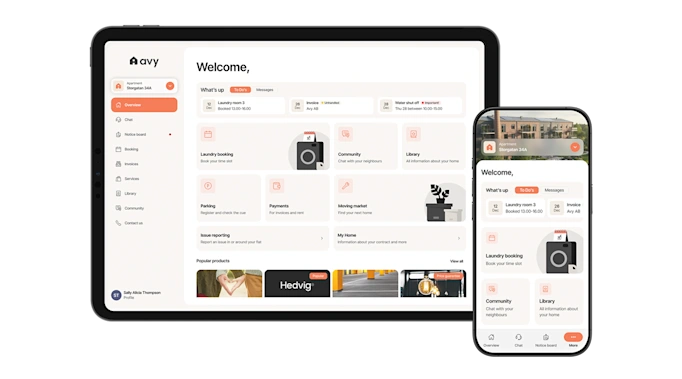
Avy: payments that power growth across markets
Avy is a customer platform for real estate, giving residents a single place to handle everything from rent to broadband. To turn payments into a driver of engagement, Avy needed low-friction and reliable payment flows. They built them with Tink.
Read more
2026-08-11
8 min read
Beyond one rail: What the next chapter of Dutch payments means for merchants
As Dutch payments evolve beyond a single rail, merchants must rethink how they balance cost, risk, settlement speed, and customer experience. Learn how payment optionality, Pay by Bank, and multi-rail strategies can help future-proof your checkout and support long-term business growth.
Read more
2026-08-11
8 min read
Beyond one rail: What the next chapter of Dutch payments means for merchants
As Dutch payments evolve beyond a single rail, merchants must rethink how they balance cost, risk, settlement speed, and customer experience. Learn how payment optionality, Pay by Bank, and multi-rail strategies can help future-proof your checkout and support long-term business growth.
Read more
Get started with Tink
Contact our team to learn more about what we can help you build – or create an account to get started right away.